


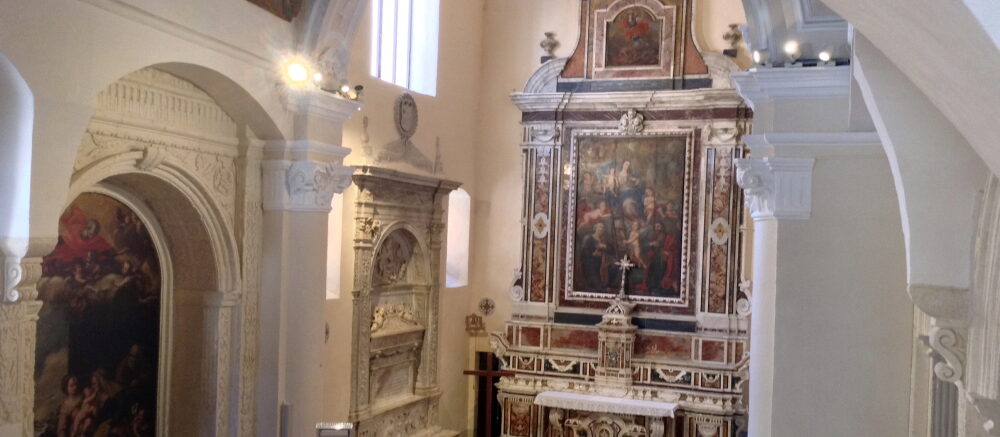
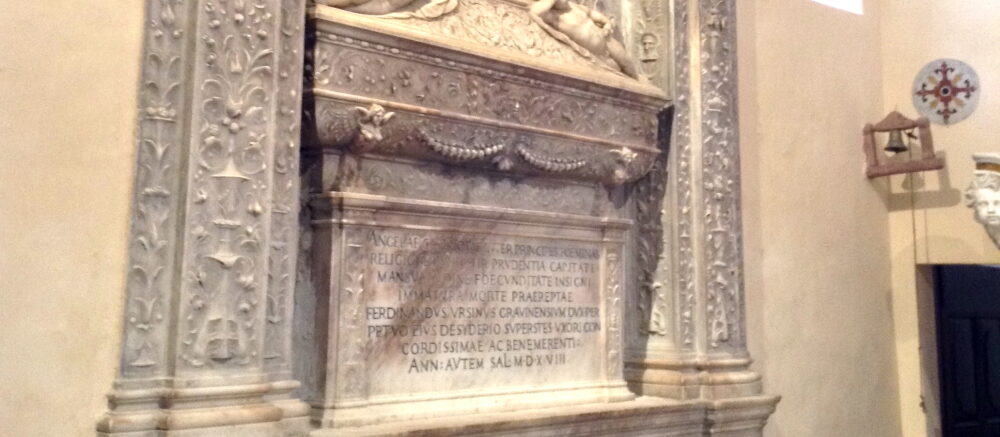

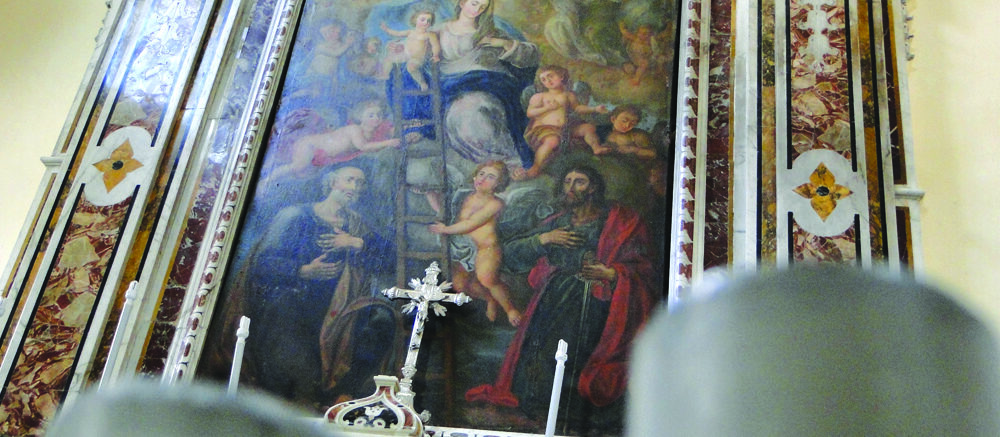
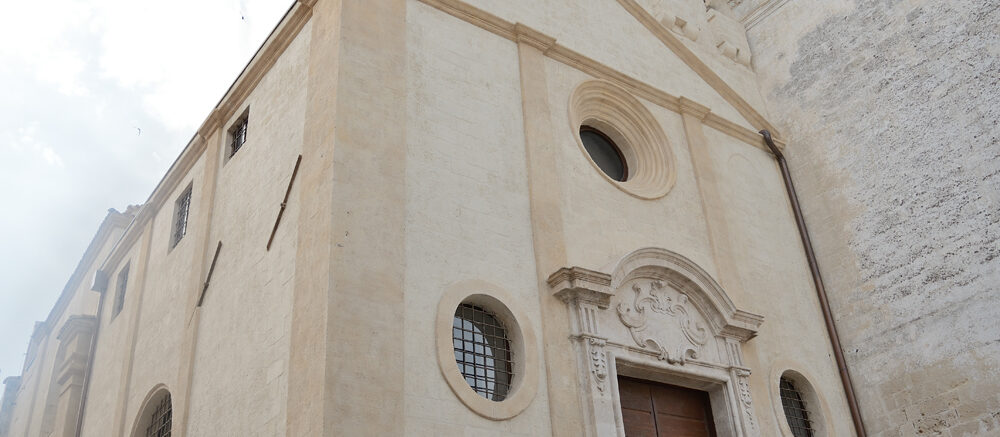
Built by Orsini dukes between ‘400 and ‘500, the church entitled to Saint Sophia has internally a lacunar ceiling with rosettes in golden wood. In the middle, there is a canvas of the Holy Family, a wooden matroneum, and an exceptional funerary monument from 1518, considered a gem of southern architecture. It preserves the remains of Angela Castriota Scanderbeg, originally Albanian and Duke Ferdinand II Orsini’s wife. The Duchess engaged in the enlargement and embellishment of the church and for this reason, her remains were put here by her husband.
The mausoleum, in fine white marble, is placed on an ornate base and along the two sides, there are the insignias of Orsini and Castriota Scanderbeg. Two lateral pilasters of flowers and leaves frame the urn on which two angels are depicted, adorned with floral friezes and drapes. The tympanum is enriched by a representation of the Madonna and Child. Attached to the church there is a renaissance monastery, built in 1539 by Duke Ferdinand and entitled to ‘Santa Maria della Scala’. It hosted Poor Clare nuns until the end of the Nineteenth century. Moreover, the monastery has a square-plan cloister with a well and Corinthian column. A century after its construction, the abbess of the monastery was a member of the Orsini Family, Fulvia, Pope Benedict XIII’s sister.
This place is included in the route:
There are no events available.
- Description
-
Built by Orsini dukes between ‘400 and ‘500, the church entitled to Saint Sophia has internally a lacunar ceiling with rosettes in golden wood. In the middle, there is a canvas of the Holy Family, a wooden matroneum, and an exceptional funerary monument from 1518, considered a gem of southern architecture. It preserves the remains of Angela Castriota Scanderbeg, originally Albanian and Duke Ferdinand II Orsini’s wife. The Duchess engaged in the enlargement and embellishment of the church and for this reason, her remains were put here by her husband.
The mausoleum, in fine white marble, is placed on an ornate base and along the two sides, there are the insignias of Orsini and Castriota Scanderbeg. Two lateral pilasters of flowers and leaves frame the urn on which two angels are depicted, adorned with floral friezes and drapes. The tympanum is enriched by a representation of the Madonna and Child. Attached to the church there is a renaissance monastery, built in 1539 by Duke Ferdinand and entitled to ‘Santa Maria della Scala’. It hosted Poor Clare nuns until the end of the Nineteenth century. Moreover, the monastery has a square-plan cloister with a well and Corinthian column. A century after its construction, the abbess of the monastery was a member of the Orsini Family, Fulvia, Pope Benedict XIII’s sister.
- Routes
-
This place is included in the route:
- Events
-
There are no events available.
- Map
-